
HyFlex Learning
HyFlex is a teaching model in which courses are designed to allow students to participate through different, as far as possible equivalent, modes of learning

Tools: source materials (texts, case studies, data), paper, a flipchart or online tools (Miro, Jamboard)
Best for: working with larger amounts of content, teaching collaboration and developing responsibility
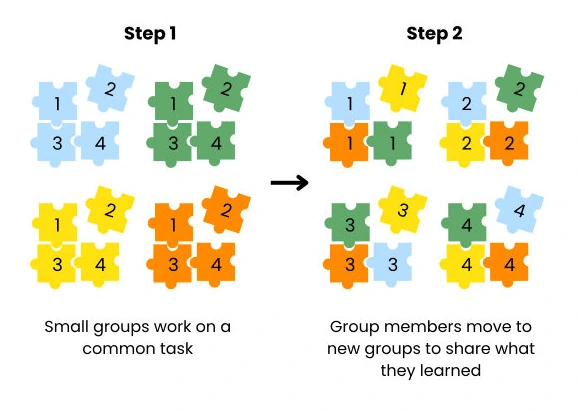
The activity begins with the teacher dividing the material into several logical sections, each of which should be important for understanding the whole problem. Students are then divided into groups, for example groups of four. In each group, every student receives a different section of the material, set of data, perspective or role. Next, students who have received the same section meet in expert groups. Together, they work to understand their section, clarify difficult points, select the most important information and prepare a way to teach it to others. Students then return to their original groups. Each person acts as an expert and teaches the others their part of the material. After sharing their knowledge, the group completes a final task together, such as solving a case study, creating a concept map, making a decision or preparing recommendations. A short summary at the end is recommended.
Course: Strategic Management
Topic: Models of Competitive Advantage
Students work to understand different project management approaches: Agile, Scrum, Waterfall and Lean. The aim of the activity is to understand when and why each of these approaches should be used in practice.
Introduction (5-10 min)
The teacher briefly sets the context: different projects require different approaches, and the choice of methodology affects both team effectiveness and project outcomes. The teacher then introduces a guiding question that will return throughout the activity and structure the analysis: when does a given methodology make sense, and when does it begin to limit the team’s work?
Expert Stage (25–30 min)
Students work in expert groups, with each group analysing one methodology using prepared materials such as a text, case study or diagram. Their task is to prepare a clear explanation that presents the core idea of the methodology in their own words, identifies the types of projects for which it works best, gives one specific example of its application and outlines one limitation or risk.
Each group prepares a short presentation lasting no more than three minutes, understandable to someone unfamiliar with the topic. During this stage, the teacher moves between groups, asks questions and checks whether students genuinely understand the material.
Formation of New Groups (25–30 min)
Students then form new groups in which each person represents a different methodology. They take turns explaining their methodology, while the rest of the group ask clarifying questions. Students make shared notes, but their main task is to understand the differences between the approaches.
Integrative Task (20 min)
Each group receives a short case study, e.g. a technology company developing a new product under strong time pressure, an infrastructure project with a clearly defined scope or a start-up testing different business ideas. The group chooses the most appropriate methodology and justifies its decision in relation to the project context.
Presentation and Reflection (20 min)
Groups present their decisions and justifications. The teacher asks why another methodology was not selected and what would change in the project if an alternative approach were used. In the reflection stage, students discuss what was most difficult to explain to others and how their understanding of the topic changed after listening to the other groups. You may also introduce a short concluding round in which students identify which methodology is most often misused and explain why.
Easier → Provide ready-made materials and specific guiding questions. Limit the scope of the content and clearly define what should be explained.
More Challenging → Add a requirement to compare approaches or critically evaluate them. Introduce a final task that requires students to integrate knowledge.
Formative Assessment
The teacher collects brief interim outputs, such as an expert note, an explanatory diagram, or responses to questions posed by other students. Developmental feedback focuses on whether the explanation is clear, accurate, and understandable to learners who were not previously familiar with that part of the material. The teacher may also suggest what should be clarified, simplified, or illustrated with an example.
Summative Assessment
Assessment focuses on a final task that requires students to apply knowledge developed through the contributions of all team members, such as a collaborative case analysis, a concept map, a problem-solving task, or a short integrative test. Assessment criteria include understanding of the student’s area of expertise, the effectiveness of communicating it to others, the ability to connect different areas of knowledge, and the application of the integrated knowledge to a new task.
Everything you need to run this method next week in your classroom.
HyFlex is a teaching model in which courses are designed to allow students to participate through different, as far as possible equivalent, modes of learning

An interactive lecture is a way of teaching a large group of students that moves beyond the traditional model of one-way knowledge transmission.

A structured essay is an academic piece of writing organised clearly and logically to present arguments or analysis effectively.